
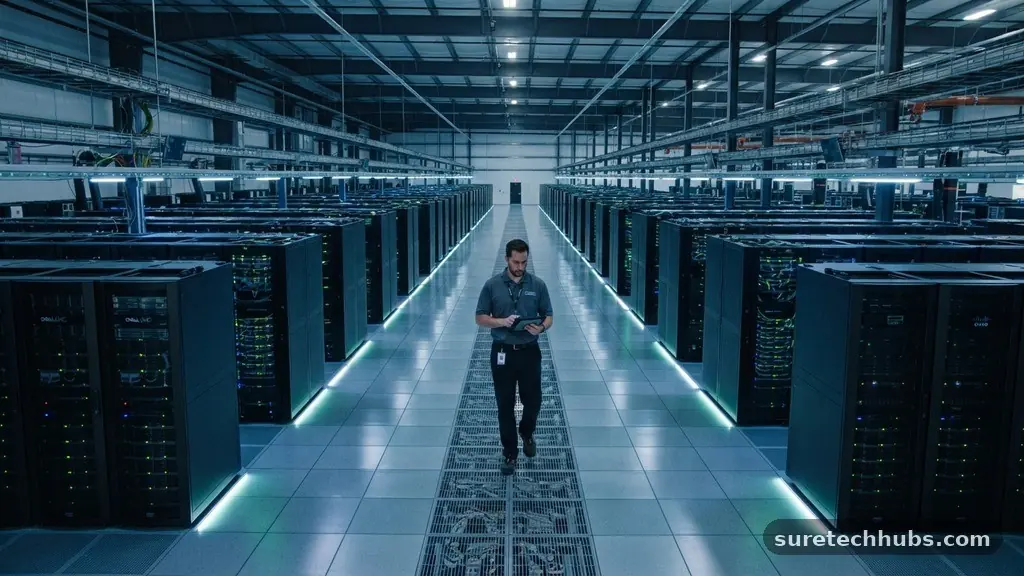
Understanding how data centers keep websites and apps running requires looking past the screen and into the physical world of massive, climate-controlled facilities. These buildings act as the backbone of our digital existence, housing the servers that process every click, search, and stream you initiate.
Without this heavy-duty infrastructure, the cloud would simply cease to function, leaving our favorite services offline. This article explores the mechanics of these facilities, explaining how they manage power, hardware, and cooling to ensure your favorite platforms stay reachable around the clock.
The Physical Foundation of Digital Operations
At the most basic level, a data center is a highly specialized warehouse designed to store and manage vast amounts of computing equipment. These facilities house thousands of servers, which are essentially high-performance computers without monitors or keyboards.
When you visit a website or launch an app, your device sends a request through the internet to one of these specific machines. The server processes that request, retrieves the necessary data, and sends it back to your screen in milliseconds.
The physical scale of these operations is staggering to consider. A single facility might span hundreds of thousands of square feet, filled with rows of metal racks that hold individual server blades.
These racks are designed to maximize airflow and density, allowing operators to pack as much processing power as possible into a limited footprint. The equipment is often bolted to raised floors to allow for complex cabling and cooling ducts to run underneath.
Reliability is the primary goal of this architecture. To keep websites and apps running, these facilities must eliminate any single point of failure.
This means having redundant power supplies, backup generators, and multiple connections to the global internet backbone. If one line of fiber-optic cable is cut, the data center automatically reroutes traffic through another path, ensuring that your connection remains stable and uninterrupted.
Managing Power and Energy Consumption
Power is the lifeblood of any data center, and the demand for electricity is immense. These facilities run 24 hours a day, 365 days a year, requiring a constant supply of high-voltage electricity to stay operational.
To ensure that an unexpected blackout doesn’t take a website offline, large-scale data centers utilize Uninterruptible Power Supply (UPS) systems. These units provide immediate battery backup, bridging the gap between a power grid failure and the activation of onsite diesel or natural gas generators.
The efficiency of energy use is measured by a metric known as Power Usage Effectiveness, or PUE. A perfect PUE score is 1.0, meaning all energy entering the building is used by the computing equipment itself.
In practice, most facilities work hard to minimize the overhead used for lighting, office space, and inefficient cooling. Many companies, such as those operating through AWS cloud services, have invested heavily in renewable energy sources to offset their massive carbon footprints.
Managing this power load involves sophisticated monitoring systems that track electricity usage in real-time. If a specific server rack begins to draw too much power, engineers can redistribute the workload to other machines.
This prevents circuit overloads and ensures that the hardware remains within its optimal operating parameters. It is a constant balancing act between demand and capacity.
The Critical Role of Cooling Systems
Servers generate an incredible amount of heat while they process data. If that heat isn’t removed, the internal hardware will overheat, leading to catastrophic system failures and data corruption.
Cooling is therefore as important as power, and it dictates much of the physical layout of the facility. Most data centers use a “hot aisle/cold aisle” configuration to manage airflow efficiently.
In this setup, rows of server racks are arranged so that their front sides face a cold aisle and their backs face a hot aisle. The facility pumps chilled air into the cold aisle, which the servers pull through their chassis to cool their components.
The resulting hot air is expelled into the hot aisle, where it is captured and sent back to the cooling units. This creates a circular flow that prevents cold and hot air from mixing, which would otherwise waste energy and lower cooling efficiency.
Some modern facilities take this a step further by using liquid cooling or even locating data centers in colder climates to take advantage of ambient air. Liquid cooling involves circulating a coolant directly over the hottest components, such as processors, to pull heat away more effectively than air ever could. This method is becoming increasingly popular as artificial intelligence workloads push server hardware to generate even higher temperatures than traditional web hosting.
Security Protocols and Physical Protection
Keeping websites and apps running safely requires more than just technical uptime; it demands rigorous physical security. A data center is a high-value target because it holds the digital assets of millions of users and businesses.
Access to these buildings is strictly controlled through multiple layers of authentication. Security personnel typically monitor the perimeter, while biometric scanners and badge readers control entry into the server halls themselves.
Beyond human guards, these facilities are monitored by extensive arrays of cameras and motion sensors. Many operators also implement “man-traps” at building entrances, which are small security vestibules that only allow one person to enter at a time.
This prevents unauthorized individuals from tailgating behind an employee. Once inside, the servers themselves are often locked in individual cages to restrict access even further.
Fire suppression is another critical aspect of physical security. Because water and electricity don’t mix, data centers rarely use standard sprinkler systems.
Instead, they rely on specialized gas-based suppression systems that displace oxygen or absorb heat to extinguish flames without damaging the sensitive electronic hardware. This ensures that even if a fire occurs, the equipment remains intact and the service stays online.
The Evolution of Modern Infrastructure
The way we build and maintain these facilities has shifted dramatically over the past two decades. Early data centers were often just repurposed office space with extra air conditioning.
Today, they are purpose-built fortresses designed from the ground up for maximum density and efficiency. The shift toward virtualization has also changed how we think about the hardware inside these rooms.
Virtualization allows a single physical server to act as dozens of independent virtual machines. This means that a service provider can host multiple apps or websites on the same piece of hardware.
This maximizes the utility of every server and reduces the amount of physical space needed to run a service. It is one of the primary reasons why the internet has been able to scale so rapidly without requiring a new building for every new website.
Software-defined networking (SDN) is another key advancement. This technology allows engineers to manage network traffic through code rather than physically unplugging and moving cables.
It allows for near-instant adjustments to bandwidth and routing as demand shifts throughout the day. When a viral event occurs and traffic spikes, the network can adjust automatically to ensure that users don’t experience a crash.
Comparing Data Center Tier Levels
The industry uses a standardized system to classify the reliability of data centers. These tiers, established by the Uptime Institute, help businesses understand the level of redundancy they can expect from a facility. A higher tier indicates a more robust infrastructure that is less likely to suffer from downtime.
| Tier Level | Redundancy | Expected Uptime |
|---|---|---|
| Tier I | Basic capacity, no redundancy | 99.671% |
| Tier II | Redundant power and cooling | 99.741% |
| Tier III | Concurrently maintainable | 99.982% |
| Tier IV | Fault-tolerant | 99.995% |
As the table shows, the difference between a Tier I and a Tier IV facility is significant in terms of annual downtime. A Tier IV facility is designed so that any single piece of equipment can fail without affecting the operation of the servers.
This level of protection is essential for banks, healthcare providers, and major social media platforms. It requires duplicate systems for every critical component, effectively doubling the infrastructure investment for the operator.
Common Hardware and Components
The equipment inside these facilities is specialized to handle constant, high-speed data processing. A typical server rack will contain a mixture of the following components:
- Network Switches: Devices that direct data traffic between the server and the broader internet.
- Storage Arrays: High-capacity drives, often SSDs, that house the databases and files for websites.
- Power Distribution Units (PDUs): Intelligent power strips that monitor and manage electricity for each rack.
- Cable Management Systems: Extensive fiber-optic and copper cabling that connects hardware to the network backbone.
- Server Blades: The primary computing modules that run the applications and scripts requested by users.
These components must be replaced on a regular cycle, typically every three to five years, to keep up with performance demands. As hardware ages, it becomes less efficient and more prone to failure.
Operators perform rolling upgrades where they swap out older machines for newer, faster, and more energy-efficient versions while the facility remains online. This constant cycle of renewal is a hidden but vital part of how the modern internet stays fast and reliable.
Frequently Asked Questions
What happens if a data center loses power?
Modern data centers are designed with multiple layers of backup. Initially, the UPS systems provide power instantly. Within seconds, large-scale diesel or natural gas generators kick in to take over the load. These generators can run for days as long as fuel is available, ensuring that the facility never goes dark during a grid outage.
Are data centers dangerous to live near?
Generally, no. Data centers are quiet, secure facilities that do not produce harmful emissions. The primary concerns for neighbors are usually noise from cooling fans and the visual impact of large, windowless buildings. They are highly regulated and do not pose a direct physical threat to the surrounding community.
Why do some companies build so many data centers?
Latency is the primary driver for building multiple locations. By placing data centers closer to the end-users, companies can deliver content much faster. If you are in London and the server is in Tokyo, there will be a noticeable delay in loading times. Spreading infrastructure globally ensures a consistent experience for everyone.
Who pays for the operation of these facilities?
The costs are typically covered by the companies that own the services we use. When you use a cloud service, you are essentially paying for a fraction of the electricity, hardware, and cooling required to host your data. These companies pass those costs on through subscription fees, advertising, or enterprise contracts.
Is the cloud just someone else’s computer?
Yes, in a literal sense, the cloud is just a collection of servers in a data center owned by a company like Google, Microsoft, or Amazon. When you upload photos or save files to the cloud, you are sending that data over the internet to be stored on those physical hard drives. The “cloud” is simply a marketing term for this remote, managed infrastructure.
The Future of Digital Infrastructure
The technology behind how data centers keep websites and apps running continues to evolve at a breakneck pace. As we demand higher resolution video, faster gaming experiences, and more powerful AI models, the infrastructure must become even more dense and efficient.
We are moving toward a future of “edge computing,” where smaller, localized data centers are placed even closer to the user to reduce latency to near-zero. This shift will make our digital experiences feel even more immediate and responsive than they are today.
Despite these changes, the fundamental mission remains the same: to provide a secure, cooled, and powered environment where hardware can process the world’s information. As you go about your day, remember that every interaction you have with an app is a testament to the complex, silent work happening inside these facilities.
Understanding the role of data centers helps us appreciate the scale of the effort required to maintain our connected world. Whether it is through smarter cooling or better power management, the ongoing innovation in this space ensures that the digital services we rely on will continue to run for years to come.