
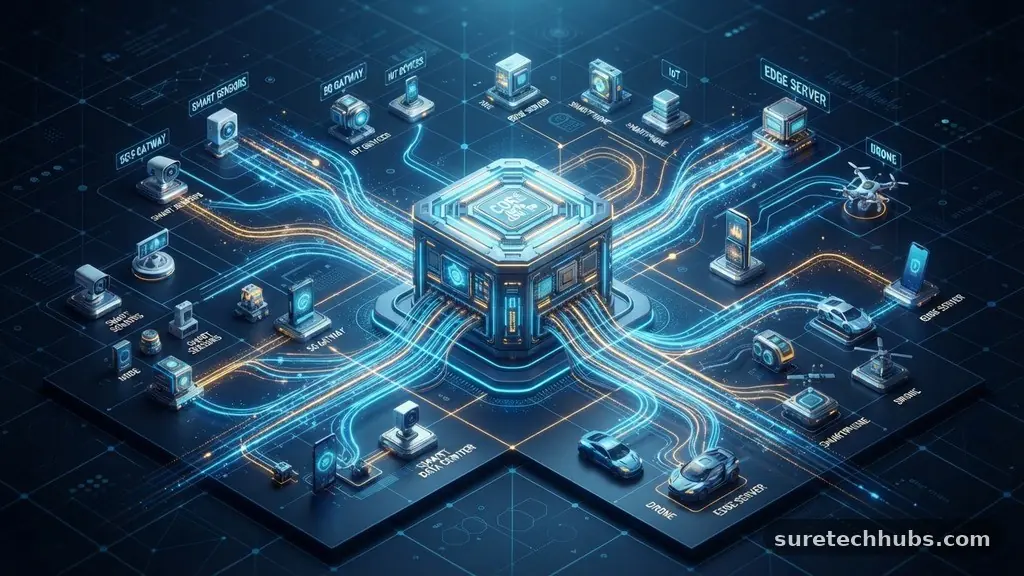
Edge computing brings data processing and storage closer to the physical location where information is generated, effectively shortening the distance data must travel. By shifting tasks from centralized data centers to the periphery of the network, organizations achieve faster response times and lower bandwidth usage.
Understanding what is edge computing and where is it used today provides a clearer picture of how modern technology handles the massive influx of information from mobile devices and smart sensors. This article examines the core mechanics of the technology, its practical applications across industries, and the tangible benefits it offers for performance-critical systems in our interconnected world.
Defining the Edge Computing Architecture
At its simplest, edge computing is a distributed computing framework that moves computation to the edge of the network. Instead of sending raw data to a distant cloud server, localized hardware processes the information on-site or at a nearby regional node.
This architectural shift addresses the inherent physical limitations of the speed of light and network congestion. By reducing the number of hops a data packet takes, systems can execute commands in milliseconds rather than seconds.
The primary goal of this model is to minimize latency, which is the time delay between a user’s action and the server’s response. In traditional cloud environments, data travels from a sensor to a data center, perhaps thousands of miles away, before returning with an instruction.
Edge computing keeps the “brain” of the operation near the “senses,” allowing for near real-time decision-making. This is essential for applications where even a fraction of a second could lead to equipment failure or safety risks.
Processing power is usually provided by edge devices, which include everything from specialized gateways to micro-data centers housed in secure cabinets. These devices filter, aggregate, and analyze data locally, only transmitting critical insights back to the central cloud for long-term storage or deep analytics.
This hybrid approach optimizes network bandwidth by preventing unnecessary traffic from clogging up the main internet backbone. It turns a massive, centralized bottleneck into a distributed, agile ecosystem.
The Mechanics of Decentralized Data
The transition from purely centralized cloud computing to an edge-heavy model relies on a sophisticated hierarchy of hardware. At the lowest level, you have the sensors and actuators that interact with the physical world.
These devices collect raw signals, such as temperature readings, video frames, or motion data. Without local processing, these devices would overwhelm the network with constant, high-volume data streams.
Edge servers act as the bridge between these sensors and the broader internet. These servers are often ruggedized to withstand harsh environments like factory floors, oil rigs, or outdoor cellular towers.
They run specialized software stacks designed to handle lightweight virtualization or containerized applications. This allows developers to deploy code that responds to local triggers instantly, without needing a constant connection to a central server.
Communication protocols play a vital role in maintaining this distributed structure. Technologies such as 5G, Wi-Fi 6, and low-power wide-area networks (LPWAN) provide the necessary connectivity for these edge units to communicate with one another.
When a local node detects an anomaly, it can coordinate with other nearby devices to rectify the situation before the central system is even notified. This autonomous capability is a hallmark of modern IoT deployments.
Practical Applications in Modern Industry
Industries across the globe have adopted this technology to solve specific operational challenges. Manufacturing is perhaps the most prominent sector, where predictive maintenance is a primary driver.
By monitoring vibration and heat patterns on a robotic arm, edge systems can detect signs of wear before a catastrophic breakdown occurs. This prevents expensive downtime and extends the life of heavy machinery.
Healthcare is another critical field where the stakes are exceptionally high. Medical monitoring devices, such as continuous glucose monitors or smart pacemakers, process health data locally to provide immediate alerts to patients and doctors.
These devices must be reliable and responsive to ensure life-saving interventions happen the moment a health event is detected. The speed of the response is directly correlated to the patient’s well-being.
Retailers also utilize these systems to enhance the customer experience through personalized engagement. Smart shelves and in-store cameras analyze shopper behavior to optimize inventory levels and suggest relevant products in real time. By keeping this processing on-site, stores protect sensitive customer information and ensure that the store’s digital infrastructure remains functional even if the external internet connection becomes unstable.
| Industry | Primary Benefit | Common Use Case |
|---|---|---|
| Manufacturing | Reduced Downtime | Predictive Machine Maintenance |
| Healthcare | Faster Response | Patient Health Monitoring |
| Transportation | Safety | Autonomous Vehicle Navigation |
| Retail | Operational Efficiency | Inventory Management |
Autonomous Systems and Transport
Transportation represents one of the most demanding environments for edge computing. Modern autonomous vehicles are essentially data centers on wheels, processing terabytes of information from cameras, LiDAR, and radar sensors every hour.
These vehicles cannot rely on a cloud connection to determine whether to brake for an obstacle. The decision-making must happen within the car’s own computing hardware in a matter of microseconds.
The data generated by these vehicles is also used to create detailed maps and traffic models. While the immediate navigation happens at the edge, the vehicle periodically offloads summarized information to the cloud to improve the software for the entire fleet.
This symbiotic relationship between the edge and the cloud is what makes large-scale autonomous driving possible. It balances the need for instant safety with the requirement for long-term learning.
Public transit and traffic management systems also benefit from this distributed approach. Intelligent traffic lights use local sensors to adjust signal timing based on real-time vehicle density, reducing congestion in urban centers.
By optimizing the flow of traffic at the intersection level, cities can significantly lower emissions and improve commuter efficiency. These systems demonstrate how localized intelligence can have a massive impact on daily life.
Improving Data Security and Privacy
One of the often-overlooked advantages of moving processing to the periphery is the potential for enhanced security. When sensitive data is processed locally, it does not need to traverse long distances across public networks.
This minimizes the “attack surface” available to malicious actors who might attempt to intercept data in transit. Organizations can keep raw, identifiable information contained within their own secure perimeters.
Compliance with data privacy regulations, such as the GDPR, becomes easier to manage when information remains local. Many jurisdictions require that sensitive user information be stored and processed within specific geographic boundaries.
Edge computing allows companies to comply with these laws by keeping the data in the country of origin rather than sending it to a central cloud server located elsewhere. This localized control is a powerful tool for global enterprises.
Encryption and identity management can also be applied more effectively at the edge. Because the processing nodes are physically closer to the source, security protocols can be tailored to the specific needs of that environment.
For example, a secure gateway in a hospital can enforce strict access controls that might be too resource-intensive to manage from a remote data center. This ensures that only authorized individuals can access sensitive medical records.
Challenges and Implementation Hurdles
Despite the clear advantages, deploying edge infrastructure is not without significant challenges. Managing a fleet of thousands of remote devices requires sophisticated orchestration tools that are more complex than managing a few centralized data centers.
Software updates, security patches, and hardware maintenance must be handled remotely, often over unreliable connections. This creates a high bar for engineering teams tasked with maintaining system uptime.
The lack of standardized hardware and software is another hurdle for widespread adoption. Different vendors often use proprietary protocols, making it difficult to create a unified system that works across various types of hardware.
Industry groups are working to develop open standards, but the market remains highly fragmented. For a deeper look into how these architectures are evolving, you can check the resources provided by the National Institute of Standards and Technology.
Energy consumption and cooling are also major factors in remote environments. Placing high-performance servers in non-traditional spaces like cell towers or warehouses requires specialized cooling solutions that are energy-efficient.
As the demand for more processing power increases, balancing performance with power constraints becomes a daily struggle for system architects. Engineers must constantly evaluate whether a specific workload is better suited for the edge or the central cloud.
Common Questions About Edge Computing
How does edge computing differ from cloud computing?
Cloud computing relies on centralized, large-scale data centers to process and store information. Edge computing, by contrast, moves that processing power to the physical location where the data is generated, such as a factory floor or a smartphone. The cloud is great for large-scale analytics and long-term storage, while the edge is optimized for speed and immediate local response.
Is edge computing the same as 5G?
No, they are different technologies that often work together. 5G is a high-speed telecommunications standard that provides the connectivity needed to move data quickly. Edge computing is the actual processing of that data. 5G makes edge computing more viable by providing the low-latency pipe required to connect edge nodes to the rest of the network.
Does my home have edge computing devices?
Yes, modern smart home devices often utilize edge processing. A smart security camera that detects motion and alerts your phone is performing local image analysis rather than sending a constant video stream to the cloud. This saves bandwidth and improves the privacy of your home network.
What are the main risks associated with edge computing?
The primary risks involve physical security and device management. Because these devices are located in remote or public areas, they are more susceptible to physical tampering. Additionally, managing thousands of distributed devices creates a complex web of potential vulnerabilities that require robust, automated security updates.
Will edge computing replace the cloud?
It is unlikely that edge computing will replace the cloud. Instead, they will coexist in a hybrid model where each handles the tasks it is best suited for. The cloud will continue to be the backbone for heavy storage and complex AI training, while the edge will handle time-sensitive, localized tasks.
The Future of Distributed Intelligence
The rapid evolution of edge computing and where it is used today marks a significant transition in how we build global digital infrastructure. By prioritizing speed and localized intelligence, we are creating systems that can react to the physical world with unprecedented precision. These advancements enable everything from safer autonomous vehicles to more efficient industrial processes and personalized healthcare.
As the underlying hardware becomes more affordable and the software tools more mature, we can expect to see this technology integrated into even more aspects of daily life. The key to success for businesses and individuals lies in recognizing which tasks require the immediate, distributed power of the edge and which are better served by the massive, centralized capacity of the cloud.
Embracing this balance will be essential for staying competitive in a world that demands instant, reliable connectivity. If you are looking to implement these solutions, start by identifying your most latency-sensitive processes and exploring how local processing could improve their performance.